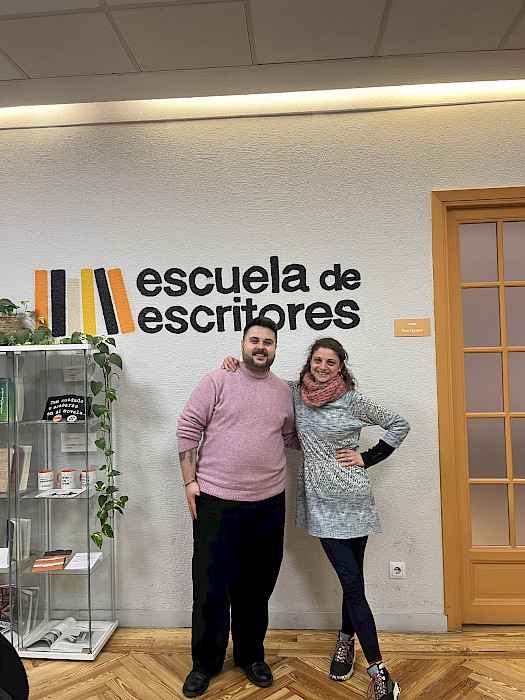
CELA Job Shadowing: Escuela de Escritores – by Monica Dimitrova (Next Page Foundation)
What are Spain's key book policies? How do you change a royal law for creative schools? What does it take to carry out partnerships with massive organizations, such as Museo Nacional del Prado? How do you attract the younger audience – both digitally and physically?
The answers to those – among many other questions – were revealed to me during my job shadowing at Escuela de Escritores in Madrid earlier this year. The job shadowing is a brilliant opportunity offered by the CELA project which allows team members to visit partner organizations within the consortium, get to know them and what they do better, discuss mutual challenges and experiences, and gather first-hand information on the cultural and book sector.
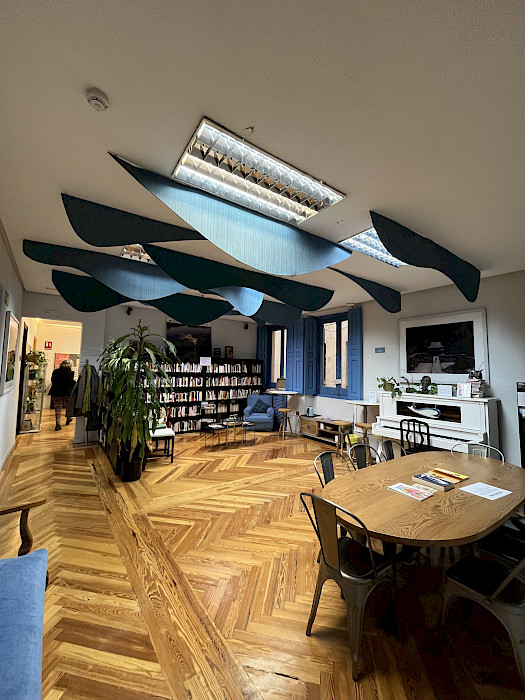
My visit started with a tour around Escuela de Escritores – which is actually quite big and each room is conceptually designed! I also got to learn a bit about its history which goes back all the way to the year 2000 with just two online groups of Taller de Escritura en Madrid / Madrid Writing Workshop.
In the next days, during meetings and informal conversations with Escuela's Marketing department and CELA coordinators, I found out curious facts about Spain's book market and reading habits in the country, Escuela's main communication campaigns and its podcast – Todo empieza con una palabra, as well as its events and activities, such as collaborations with El Prado, Penguin Random House, and SER radio station – the biggest and most listened-to radio station in Spain.
Collaborating with an institution such as El Prado is both an ambitious and rewarding endeavour. Escuela de Escritores has at least 3 projects with the Museum I was so curious to learn more about. One of them is Escritura Epistolar / Epistolary Writing, a blend of art and writing in which people aged 16 - 23, inspired by works displayed in El Prado, create stories in form of letters, received by people aged 65 - 90 at the Museum of Fine Arts of Asturias who in their turn respond with another letter based on paintings from the Asturian Art Gallery.
The other project is the writing workshop Tus Palabras y el Museo / Your Words and the Museum in which participants are mentored by writing teachers and provided with narrative techniques and tools to sharpen their perspective and create a narrative story, based on one of the works in the Museum’s galleries. The third initiative is the international short story contest El Prado en 205 Palabras / El Prado in 205 Words in which participants are invited to write a short story, based on 5 selected artworks on display at the Museum. The winners' texts were displayed on a poster alongside the work that inspired it.
The next initiative that excited me is a literary urban intervention in which La Plaza del Conde de Barajas is transformed into La Plaza del Libro, an oasis in the heart of Madrid to relax and unwind with a good book in hand and in the company of other book lovers. Penguin Random House – another institution, was a partner in the project.
On my last day in Madrid I was invited to accompany Javier Sagarna, director of Escuela de Escritores, at SER radio station – the biggest in Madrid and arguably with the most spectacular 360-degree view of the city. The occasion was yet another brilliant initiative – the contest Relatos en Cadena / Chain Stories. It is a weekly contest for micro-stories in which the opening line of each micro-fiction piece needs to be the last line of the winning entry from the previous week. The stories of the 3 finalists are read by actors on the air and the winner is selected and announced.
To make my stay in Madrid even more fulfilling, my job shadowing coincided with the residency of the students from the recently created International Master Creative Writing, a collaboration between 3 leading European writing schools – ArtEZ University of the Arts (Netherlands), Escuela de Escritores (Spain) and Scuola Holden (Italy). Thanks to that time alignment I got the chance to attend a lecture on Madrid and literature, a literary walk around El Barrio de las Letras, a historic district known for having been home to the great writers of Spain's Golden Age, such as Miguel de Cervantes, Lope de Vega, and Quevedo, and an inspiring night of reading by the students themselves which introduced me to their beautiful emerging talents.
Another alignment in my personal schedule led to the reunion with Spanish writer and a friend of mine José Carlos Somoza, whom I met in 2016 while working for the Sofia International Literary Festival where he was a guest. While catching up and sharing a paella, I came to the thought that – somehow – it is all connected to literature.
Monica Dimitrova has spent the last 14 years in the culture sector, managing events and logistics, coordinating locations and designing communication campaigns. She has a PhD in Communication and Media Studies and has been a part of the Next Page Foundation / Sofia Literature and Translation House since 2021.